Showing posts with label Species and Breeds. Show all posts

Wednesday, July 18, 2012

Big Poitevin Mules by Crossing a Poitou Donkey with a Mulassiere

image

Large French mules were strong and hardy, but they are now very rare.

Mules are produced by mating a male donkey with a female horse. The offspring acquires a combination of characteristics from both parents – they are neither horses nor donkeys.


Baudet de Poitou, or Mammoth Poitou Donkey

The Baudet was developed around Poitiers in France specifically to produce large mules, that were exceptionally good working animals. Mules are stronger than horses of an equivalent size, so big mules are very tough animals:

  • Characteristic features of the Baudet, in addition to its enormous size include very big ears and a long shaggy coat.
  • Extremely matted and tangled coats are favoured, and animals with good 'cadanettes' are the most valuable.

  • Although Baudets were once common in the region, they are now becoming rare, and breeders usually prefer to use them to produce more donkeys, rather than to cross them with horse mares and 'waste' a year.
Mulassiere Mares

image

The same region in France (Poitou-Charente) also has a very large breed of working horse, the 'Mulassiere'.

These have become rare now, and as with the Poitou donkey breeders tend to concentrate on keeping the breed alive rather than producing sterile mules.

Poitevin Mules

Mules are very strong and were used for heavy farm work. They can appear stubborn at times, but that is probably because they are more intelligent than horses or donkeys.

A horse can be made to work until it is harmed, but a mule refuses to put itself in danger. If urged to do something that it considers foolhardy a mule will simply dig its heels in and refuse (very sensible!).

The Poitevin Mule was an animal designed to benefit from these mule characteristics, while breeding the largest animal possible.

Rare Farm Breeds

Many local breeds of farm animals are either very rare or extinct (see ' Mangalitza Wooly Pig ' as a good example ).

Intensive farming relies on a small number of 'modern' breeds for meat production, and working farm animals have now been replaced by tractors. There is simply no longer much need for large, strong, animals.

The only hope for the survival of these rare breeds lies in the hands of enthusiasts – people who accept the challenge of keeping them and their characteristics alive.

It is not surprising that enthusiasts who are dedicated to preserving the Poitou Donkey (or the Mulassiere Horse) should be more concerned about establishing a good stock of these animals, rather than crossing them to produce mules.

The Poitevin Mule is now an extremely rare animal, but as long as the Poitou Donkey and the Mulassiere Horse survive there is hope for them. It would be possible to produce them again in the future.

Source: John Blatchford. http://suite101.com

Thursday, June 21, 2012

THE MAMMOTH JACK


Most of us can recognize a donkey. The very first donkey was thought to be the Syrian Wild Ass, whose descendants were described in both the Bible and in historical and literary accounts. In the Christmas story Mary rode a little donkey led by Joseph. In 16th century Spain the famous writer Cervantes wrote about Don Quixote and his sidekick, Sancho Panza, who rode a small donkey. Even George Washington used donkeys to produce mules for riding and for farm work. Some of us have come to know donkeys because of a children's novel called "Brighty of the Grand Canyon," based on the true story of a little gray donkey named Bright Angel, who wandered the North and South Rims of Arizona's Grand Canyon in the early 1900s.

Donkeys, known mostly from their long ears, the black markings across their withers and down their back, and their mostly-hairless tails with the tuft at the end, are classified by size: Miniature, Standard, Large Standard, and Mammoth. Male donkeys are called jacks, and female donkeys are jennets. The American Mammoth Donkey of today is the descendant of imported Maltese, Poitou, Andalusian, Majorcan, and Catalonian donkeys. The Maltese donkeys came from the island of Malta; they are most often no taller than 13.3 hands and black. The Poitou donkey, from France but thought to be descendants of Majorcan or Catalonian donkeys from Spain, have a long, curly coat of dark brown or black fur which is a real challenge to keep clean and sleek. Today's Poitou donkey is very rare, even in France, to the point of extinction. The Andalusian donkey, often between 14.2-15 hands, was primarily dappled grey and red roan, often with a large head, a thick jaw, and a Roman nose. The Catalonian donkey, always black, is finer-boned and less drafty-looking than the Andalusian variety, often 15 hands but fine of bone. Today there is only a very tiny number of Catalonian donkeys in Spain and in Mexico. The Majorcan donkey, also from Spain, is taller than the Maltese donkey. So many Majorcan donkeys were imported from Spain that there are no known populations in Spain today.

To be registered as Mammoth, the male donkey should be at least 14.2 hands, and the female should be at least 14.0 hands, about the size of a very large riding pony. According to the American Livestock Breeds Conservancy, fewer than 1000 Mammoth donkeys are registered in the United States each year, making them quite rare. When machinery and tractors were introduced to American farms during the 1940s and 1950s, the Mammoth donkey, like working horse breeds used for farm work, was nearly lost. Today the Mammoth donkey can be black, chestnut, spotted, dun, white, dapple gray, bay, or palomino, and some may even have a four-beat gait like a Tennessee Walking Horse. The chestnut color is very common in Mammoth donkeys that are built like draft horses. This month's Mammoth jack is a chestnut roan; the areas around the eyes, up the legs, and on the underside of the body are lighter in color than the other regions of his body.

One of the better known Mammoth Jacks of the twentieth century was Jen-Jack, a gray Mammoth bought as a jack foal by a Mr. Berry from Willis Grumbein of Dodge City, Kansas. Mr. Berry had such bad eyesight that he believed he had bought a jennet foal. When visitors to Mr. Berry's farm observed that the jennet foal was really a jack foal, Mr. Berry decided to name him Jen-Jack. Jen-Jack sired some well-known Mammoth donkeys, among them, Bully Boy, Amarillo Slim, Finally Friday, Too Tall Jones, and Bramoth Ebony.

The Mammoth Jack has come a long way from the first little Syrian Wild Ass. He has evolved into a tall, sturdy, reliable equine capable of doing an honest day's work in the fields, showing in halter and performance classes, and carrying riders for a pleasurable ride. He also has his own fan club, the North American Saddle Mule Association (NASMA), one of whose famous members is the noted veterinarian, author, and horse-training clinician, Dr. Robert Miller.

Source: Diane Jones, Windt im Wald Farm

Sunday, June 17, 2012

Four Kinds of Donkey


by Paul & Betsy Hutchins

Donkeys range in size from 300-pound minis to American Mammoth jackstock, which may be as big as draft horses and capable of handling similar work. Mammoth jacks are often crossed with draft mares, most commonly Belgian or Percheron, to produce draft mules.

Miniature Mediterranean Donkey—Originally imported from Sicily and Sardinia and colloquially referred to as Sicilian donkey. A miniature must be less than 36" at the withers to be registered as miniature by the American Donkey and Mule Society.

Standard Donkey—Most donkeys in the world are in this size range. Often called burros, they stand between 36.01" and 48" at the withers and are further divided into:

  • Small Standard—36.01" to 40"
  • Standard—40.01" to 48"
  • Large Standard—48.01" to 54" (jennets) and 48.01" to 56" (jacks)

Mammoth or American Standard Jack Stock—This breed is the largest donkey in the world. Jacks must stand 56" or more, and jennets must be 54" and up. The correct name for this breed is American Standard, but the common name is Mammoth, which helps avoid confusion with standard donkeys.

American Spotted Ass—Donkeys of all sizes can have pinto or spotted coloring. The term American Spotted Ass is a trademark for asses registered with the American Council of Spotted Asses, which is attempting to establish foundation stock for this breed.

Source: http://www.ruralheritage.com

Thursday, June 7, 2012

Catalan donkey


The Catalan donkey (Catalan: ruc català; Eastern Catalan: [ˈruk kətəˈɫa], Western Catalan: [ˈruk kataˈla]; Equus asinus) is the local donkey of Catalonia (North eastern Spain). It is sometimes also called the Catalonian ass.

image

History

The Catalan donkey is related to the donkey of Mallorca and the zamorano-llionés donkey. The breed is considered to be very old;Pliny the Elder mentioned that there were donkeys on the plain of Vic.

In the past the donkey was very important on farms but due to declining use and numbers the Catalan donkey was in danger ofextinction. There once were as many as 50.000, but these days there are only about 500 left, of which more than 100 are outside Catalonia.

After winning several shows and contests, the Catalan donkey is called 'the best donkey in the world', especially for pulling carts and as pack animal.

It is one of the base breeds of the donkey of Mallorca and the North American donkey. Its properties have contributed to improving donkey breeds elsewhere in the world.


Characteristics

  • Height: ca. 1,65 m from feet to head. It is one of the tallest kind of donkeys.
  • Weight: a full grown donkey can weigh up to 500 kg.
  • Coat: in summer short and black hair all over the body up to its mouth, white from the eyes and on the belly. In winter longer chestnut colored hair all over the body.
  • Ears: straight and pointy.
  • Food: grass.
  • Habitat: forests.

Symbolism

Recently, advocats of Catalan nationalism have adopted the Catalan donkey as a symbol opposite the Toro de Osborne, typical for Castile and Andalusia.

There are also stickers for cars and scooters. A few people also do not regard the catalan donkey as a symbol of Catalonia, but only as a way to try ridicule the Castillian bull.

Source: http://en.wikipedia.org

Tuesday, June 5, 2012

Onager


image

image

The onager (Equus hemionus) is a large member of the genus Equus of the family Equidae (horse family) native to the deserts of Syria, Iran, Pakistan, India, Israel and Tibet. It is also known as the Asiatic wild ass, Asian wild ass or wild Asian ass (in which case the term "onager" is reserved for the E. h. onager subspecies, more specifically known as the Persian onager).

Like many other large grazing animals, the onager's range has contracted greatly under the pressures of hunting/poaching andhabitat loss. Of the five subspecies, one is extinct and at least two are endangered (their status in China is not well known).

The kiang (E. kiang), a Tibetan relative, was previously considered to be a subspecies of the onager as E. hemionus kiang, but recent molecular studies indicate that it is a distinct species.

The specific name is Ancient Greek ἡμίονος (hēmíonos), from ἡμι- (hēmi-), half, and ὄνος (ónos), donkey; thus, half-donkey or mule. In Persian the archaic word gur preserves the second syllable of the common Indo-European term that includes ona/ono(donkey) and ger/gur (swift).

Onagers are a little larger than donkeys at about 290 kilograms (640 lb) and 2.1 metres (6.9 ft) (head-body length), and are a little more horse-like. They are short-legged compared to horses, and their coloring varies depending on the season. They are generally reddish-brown in color during the summer, becoming yellowish-brown in the winter months. They have a black stripe bordered in white that extends down the middle of the back. They are notoriously untameable. Equids were used in ancient Sumer to pull wagons circa 2600 BC, and then chariots on the Standard of Ur, circa 2000 BC. Clutton-Brock (1992) suggests that these were donkeys rather than onagers on the basis of a "shoulder stripe". However, close examination of the animals (equids, sheep and cattle) on both sides of the piece indicate that what appears to be a stripe may well be a harness, a trapping, or a joint in the inlay. For Sumerian references to onagers, see Heimpel (1968) and Maekawa (1979).


Subspecies

According to the International Union for Conservation of Nature, "the taxonomic relationships and distributions of Asiatic wild assess should be clarified." Widely recognized subspecies include:

  • Mongolian wild ass (khulan) Equus hemionus hemionus
  • Turkmenian kulan, (kulan) Equus hemionus kulan
  • Persian onager (gur) Equus hemionus onager
  • Indian wild ass (khur) Equus hemionus khur
  • Syrian wild ass, Equus hemionus hemippus (extinct)

A sixth possible subspecies, the Gobi khulan (E. h. luteus, also called the chigetai or dziggetai) has been proposed, but may be syonymous with E. h. hemionus.


Source: http://en.wikipedia.org/

Monday, June 4, 2012

African wild ass

image

image

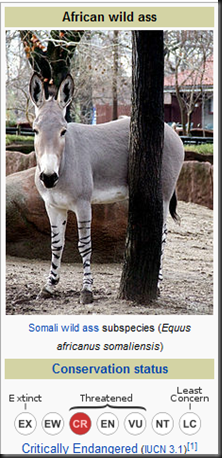
The African wild ass (Equus africanus) is a wild member of the horse family, Equidae. This species is believed to be the ancestor of the domestic donkey which is usually placed within the same species. They live in the deserts and other arid areas of the Horn of Africa, in Eritrea, Ethiopia and Somalia; it formerly had a wider range north and west into Sudan, Egypt and Libya. About 570 individuals exist in the wild.

Taxonomy

Different authors consider the African wild ass and the domesticated donkey one or two species; either view is technically legitimate, though the former is phylogenetically more accurate.

The species name for the African wild ass is sometimes given as asinus, from the domestic donkey, whose specific name is older and usually would have priority. But this usage is erroneous since the International Commission on Zoological Nomenclature has conserved the name Equus africanus in Opinion 2027. This was done to prevent the confusing situation of the phylogenetic ancestor beingtaxonomically included in its descendant.

Thus, if one species is recognized, the correct scientific name of the donkey is E. africanus asinus.

The first published name for the African wild ass, Asinus africanus Fitzinger, 1858, is a nomen nudum. The name Equus taeniopus von Heuglin, 1861 is rejected as indeterminable, as it is based on an animal that cannot be identified and may have been a hybrid between a domestic donkey and a Somali wild ass; the type has not been preserved. The first available name thus becomes Asinus africanusvon Heuglin & Fitzinger, 1866. A lectotype is designated: a skull of an adult female collected by von Heuglin near Atbarah River, Sudan, and present in the State Museum of Natural History Stuttgart, MNS 32026. The two subspecies recognized are the Nubian wild ass Equus africanus africanus (von Heuglin & Fitzinger, 1866),and the Somali wild ass Equus africanus somaliensis (Noack, 1884).


Description

The African wild ass is 2 metres (6.6 ft) long and 1.25 to 1.45 metres (12.1 to 14.1 h) (51 to 59 in) tall at the shoulders, with a tail 30–50 centimetres (12–20 in) long. It weighs between 230–275 kilograms (510–610 lb). The short, smooth coat is a light grey to fawn colour, fading quickly to white on the undersides and legs. There is a slender, dark dorsal stripe in all subspecies, while in the Nubian wild ass E. a. africanus, as well as the domestic donkey, there is a stripe across the shoulder. The legs of the Somali wild ass E. a. somaliensis are horizontally striped with black, resembling those of a zebra. On the nape of the neck, there is a stiff, upright mane, the hairs of which are tipped with black. The ears are large with black margins. The tail terminates with a black brush. The hooves are slender and approximately the diameter of the legs.


Habitat

African wild asses are well suited to life in a desert or semidesert environment. They have tough digestive systems, which can break down desert vegetation and extract moisture from food efficiently. They can also go without water for a fairly long time. Their large ears give them an excellent sense of hearing and help in cooling. Because of the sparse vegetation in their environment wild asses live somewhat separated from each other (except for mothers and young), unlike the tightly grouped herds of wild horses. They have very loud voices, which can be heard for over 3 km (1.9 mi), which helps them to keep in contact with other asses over the wide spaces of the desert.


Behavior

The African wild ass is primarily active in the cooler hours between late afternoon and early morning, seeking shade and shelter amongst the rocky hills during the day. Swift and sure-footed in their rough, rocky habitat, the African wild ass has been clocked at 50 km/h (30 mph). Mature males defend large territories around 23 square kilometers in size, marking them with dung heaps - an essential marker in the flat, monotonous terrain. Due to the size of these ranges, the dominant male cannot exclude other males. Rather, intruders are tolerated - recognized and treated as subordinates, and kept as far away as possible from any of the resident females. In the presence of estrous females, the males bray loudly. These animals live in loose herds of up to fifty individuals.

Wild asses can run swiftly, almost as fast as a horse. However, unlike most hoofed mammals, their tendency is to not flee right away from a potentially dangerous situation, but to investigate first before deciding what to do. When they need to, they can defend themselves with kicks from both their front and hind legs. Equids were used in ancient Sumer to pull wagons circa 2600 BC, and then chariots on the Standard of Ur, circa 2000 BC. These have been suggested to represent onagers, but are now thought to have been domestic asses. (Clutton-Brock)


Diet

The African wild asses' diet consists of grasses, bark, and leaves. Despite being primarily adapted for living in an arid climate, they are dependent on water, and when not receiving the needed moisture from vegetation, they must drink at least once every three days. However, they can survive on a surprisingly small amount of liquid, and have been reported to drink salty or brackish water.


Conservation status

Though the species itself is under no threat of extinction, due to abundant domestic stock (donkey and burros), the two extant wild subspecies are both listed as critically endangered. African wild asses have been captured for domestication for centuries, and this, along with interbreeding between wild and domestic animals, has caused a distinct decline in population numbers. There are now only a few hundred individuals left in the wild. These animals are also hunted for food and for traditional medicine in both Ethiopia and Somalia, where recent civil unrest has led to an increased number of weapons in circulation. Competition with domestic livestock for grazing, and restricted access to water supplies caused by agricultural developments, pose further threats to the survival of this species. The African wild ass is legally protected in the countries where it is currently found, although these measures often prove difficult to enforce. A protected population of the Somali wild ass exists in the Yotvata Hai-Bar Nature Reserve in Israel, to the north of Eilat. This reserve was established in 1968 with the view to bolster populations of endangered desert species. Populations of horses and asses are fairly resilient, and if the species is properly protected it may well recover from its current low.


In captivity

image

There are about 150 individual Somali wild asses living in zoos around the globle of which 36 were born at Zoo Basel, where this species's breeding program started with Basel's first Somali wild asses in 1970 and the first birth in 1972.

Zoo Basel manages the European studbook for the Somali wild ass and coordinates the European Endangered Species Programme (EEP).All European and American wild donkeys are either descendants of the original group at Zoo Basel or of 12 others that came from the Yotvata Hai-Bar Nature Reserve in Israel in 1972.

Source: http://en.wikipedia.org